Defining Pool Construction in Greenwich
Greenwich, Connecticut needs no introduction. Stretching from the New York state line east to Stamford, this town of 63,000 residents encompasses some of the most valuable residential real estate in the world. The backcountry estates along Round Hill Road and North Street sit on parcels measured in acres, not fractions thereof. Waterfront compounds on Indian Harbor, Belle Haven, and Field Point circle the southern edge of town where Long Island Sound meets carefully maintained private shoreline. Between these extremes, neighborhoods like Riverside, Old Greenwich, and Cos Cob each carry their own architectural identity and outdoor living expectations.
In Greenwich, a swimming pool is a fundamental component of the residential landscape. These are properties where every element — from the Belgian block motor court to the copper gutters to the specimen plantings — is selected and executed at the highest level. The pool must meet that same standard. Gedney Pools LLC provides Greenwich homeowners with custom gunite pool construction backed by extensive pool construction experience.
Greenwich's Diverse Landscape and Pool Design
Few towns present the range of site conditions found in Greenwich. The backcountry — that rolling terrain north of the Merritt Parkway along Round Hill Road, Dingletown Road, and Taconic Road — features large lots with significant elevation changes, mature tree canopies, and exposed rock formations. Pools in this area often require substantial excavation, and the granite bedrock common in northern Greenwich demands experienced handling. These properties reward designs that work with the terrain: vanishing edge pools set into hillsides, naturalistic freeform pools surrounded by indigenous stone, or elevated pools with panoramic views across wooded valleys.
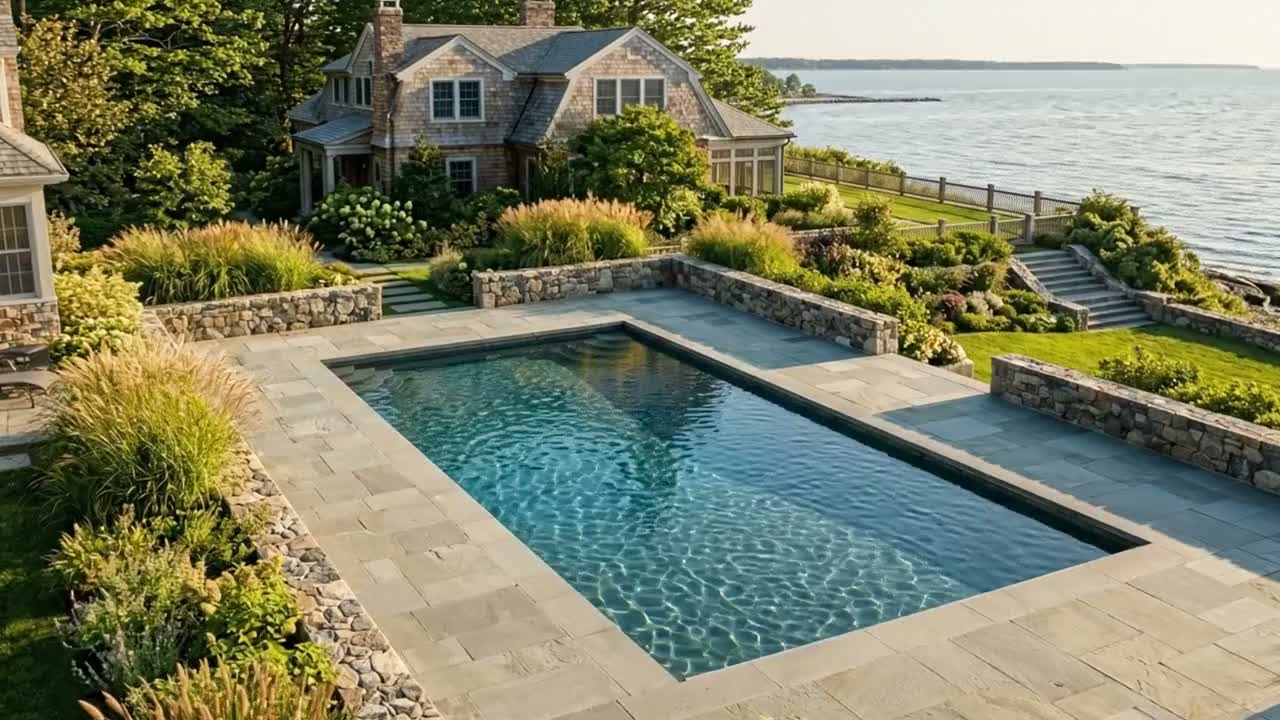
Move south toward the water and the conditions change entirely. Properties in Belle Haven, a private gated community on a peninsula in Greenwich Harbor, feature manicured grounds where formal rectangular pools with limestone coping complement shingle-style and Georgian residences. Along Shore Road in Old Greenwich and Tod's Point vicinity, the proximity to the Sound and the prevailing onshore breezes influence both pool placement and the selection of surrounding materials.
Mid-country Greenwich — the corridor between the Post Road and the Merritt Parkway along Lake Avenue, Doubling Road, and Stanwich Road — offers its own character. Lot sizes typically range from one to four acres, large enough for substantial pool installations but requiring thoughtful integration with existing landscape architecture. Many of these properties include tennis courts, pool houses, and guest cottages, and the pool must function as part of a cohesive outdoor complex.
Country Club Culture and Outdoor Living
Greenwich's club culture reinforces the centrality of pools and outdoor recreation. Members of the Greenwich Country Club, Milbrook Club, Burning Tree Country Club, Round Hill Club, Indian Harbor Yacht Club, and the Field Club understand premium aquatic facilities firsthand. When they commission pools for their private residences, they expect the same level of design sophistication and construction quality they experience at these institutions.
This is why gunite construction is the only appropriate method for Greenwich properties. Gunite allows complete design freedom — any shape, any depth, any feature — and delivers structural performance measured in decades. Combined with premium finishes like glass tile, natural stone coping, and Pebble Technology surfaces, a gunite pool becomes a permanent architectural feature that enhances both the livability and value of the property.
Greenwich Permitting and Regulatory Landscape
Pool construction in Greenwich requires navigating the town's Planning and Zoning Commission regulations, which include setback requirements that vary by zone. The RA-4 zone (four-acre minimum) that covers much of backcountry Greenwich has different provisions than the R-6 zone common in Old Greenwich and Riverside. Properties within 100 feet of wetlands or watercourses require approval from the Inland Wetlands and Watercourses Agency, and coastal properties face additional review under the town's Coastal Site Plan Review process.
Greenwich also has a tree preservation ordinance that affects pool placement on many properties. Removing trees above a certain caliper within the building setback requires a permit and potentially replacement plantings. The Historic District Commission reviews exterior modifications — including pools and pool houses — on properties within designated historic areas.
Gedney Pools manages the complete permitting process, from initial zoning analysis through survey, engineering, application submission, and final inspection. We have working relationships with the departments and commissions involved and understand Greenwich's regulatory expectations thoroughly.
Pool Installations Designed for Greenwich
- Estate-scale vanishing edge pools on backcountry properties along Round Hill, North Street, and Conyers Farm, where elevation and views justify dramatic infinity-edge treatments
- Formal pools with pool houses for Belle Haven, Milbrook, and Field Point properties where classical architecture demands symmetry and refinement
- Comprehensive outdoor living installations combining pool, raised spa, water features, outdoor kitchen, and entertainment terrace for mid-country estates
- Waterfront pools for properties along Greenwich Harbor, Indian Harbor, and the Old Greenwich coastline, designed to withstand coastal conditions and complement marine views
- Full-scale renovations of existing pools on Greenwich properties, including structural upgrades, new mechanical systems, and contemporary aesthetic treatments
Investment and Timeline
Custom pool construction in Greenwich typically ranges from $250,000 for well-appointed standard installations to $500,000 and beyond for complex projects involving vanishing edges, extensive stonework, pool houses, and multi-level terracing. The backcountry properties with rock excavation requirements may carry additional site preparation costs. Construction timelines run 12 to 20 weeks depending on project scope and site conditions, with permitting adding 6 to 10 weeks prior to groundbreaking.